TWINS: A Tactile Wearable Isomorphic Arm Networked System for Contact-Rich Manipulation Learning

Takahide Kitamura, Masaki Murooka, Natsuki Yamanobe, Yukiyasu Domae
Equal contribution
National Institute of Advanced Industrial Science and Technology (AIST), Japan

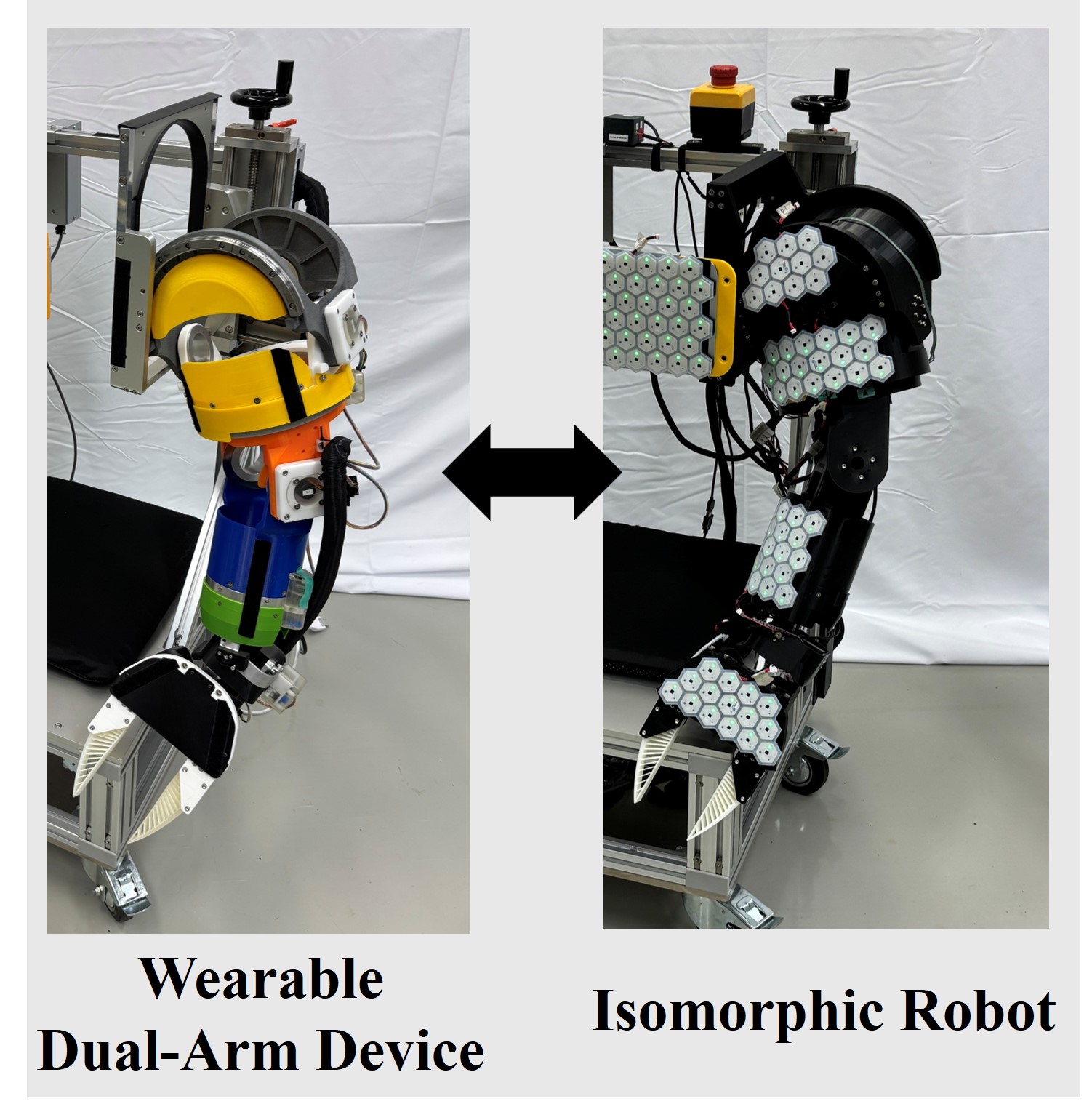
TWINS unifies demonstration, learning, and execution of manipulation involving body-surface contact through a wearable device and an isomorphic robot.

Abstract

Recent advances in robot learning for manipulation have increased the importance of collecting real-world demonstration data. However, existing robotic systems primarily focus on end-effector manipulation, making it difficult to teach and execute tasks involving body-surface contact with the arms and chest. We present TWINS, a robotic system composed of a Wearable Dual-Arm Device and an Isomorphic Robot with the same joint configuration and external dimensions. Distributed tactile sensors embedded in the chest and arms measure body-surface contact in sync with joint motion. Demonstrations collected for four contact-rich manipulation tasks are used to train imitation learning policies, enabling manipulation guided by body-surface tactile observations.
TWINS Platform

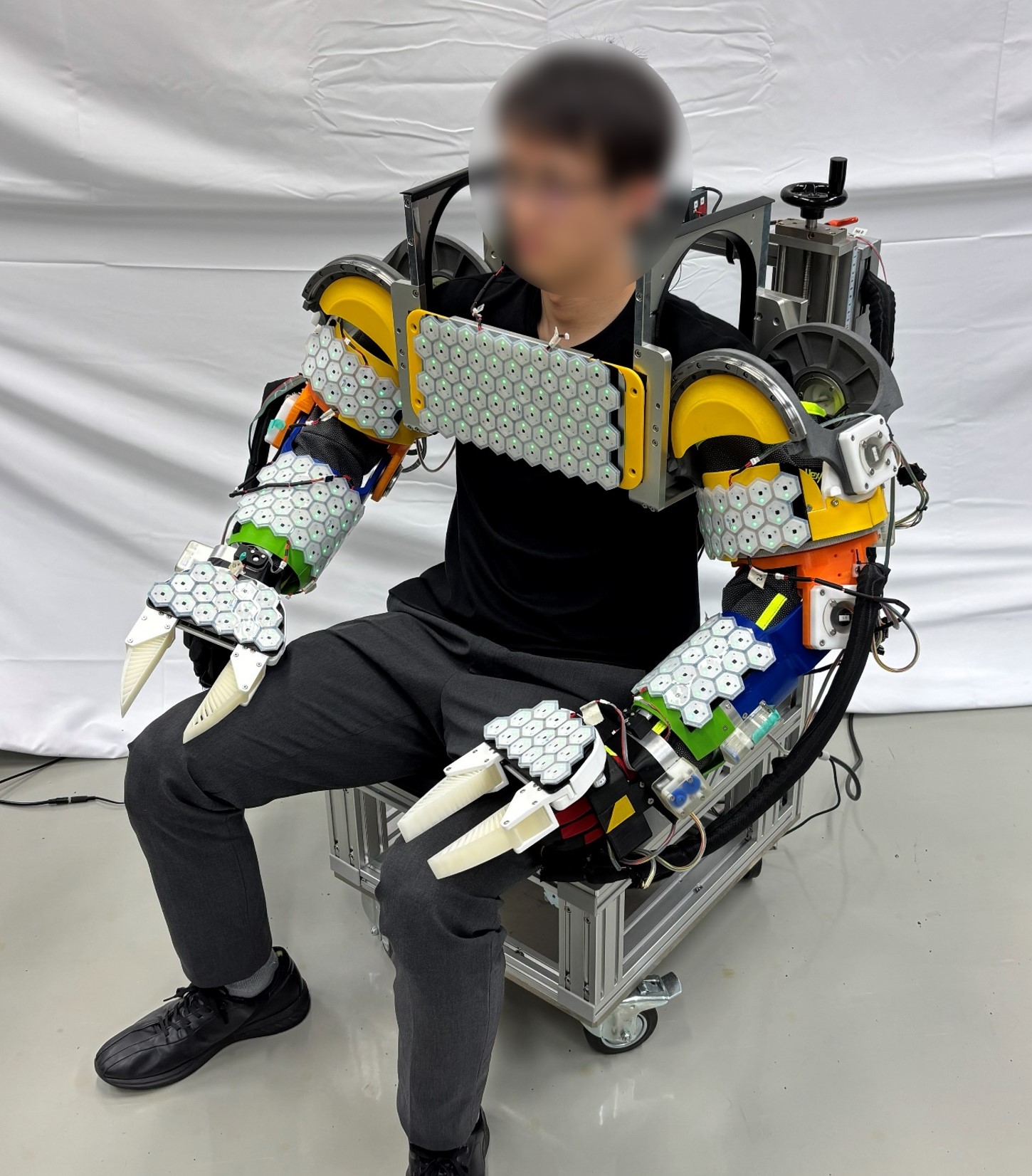
TWINS unifies embodied demonstration, isomorphic motion transfer, and distributed body-surface tactile sensing in a single platform for collecting and learning contact-rich manipulation.

01 · Wearable embodiment

Step inside the robot's body

The operator inserts their arms into the hollow wearable device and physically interacts with objects through its robot-shaped outer shell, enabling intuitive demonstration of body-surface contact.

Operator wearing the TWINS Wearable Dual-Arm Device
Wearable Dual-Arm Device
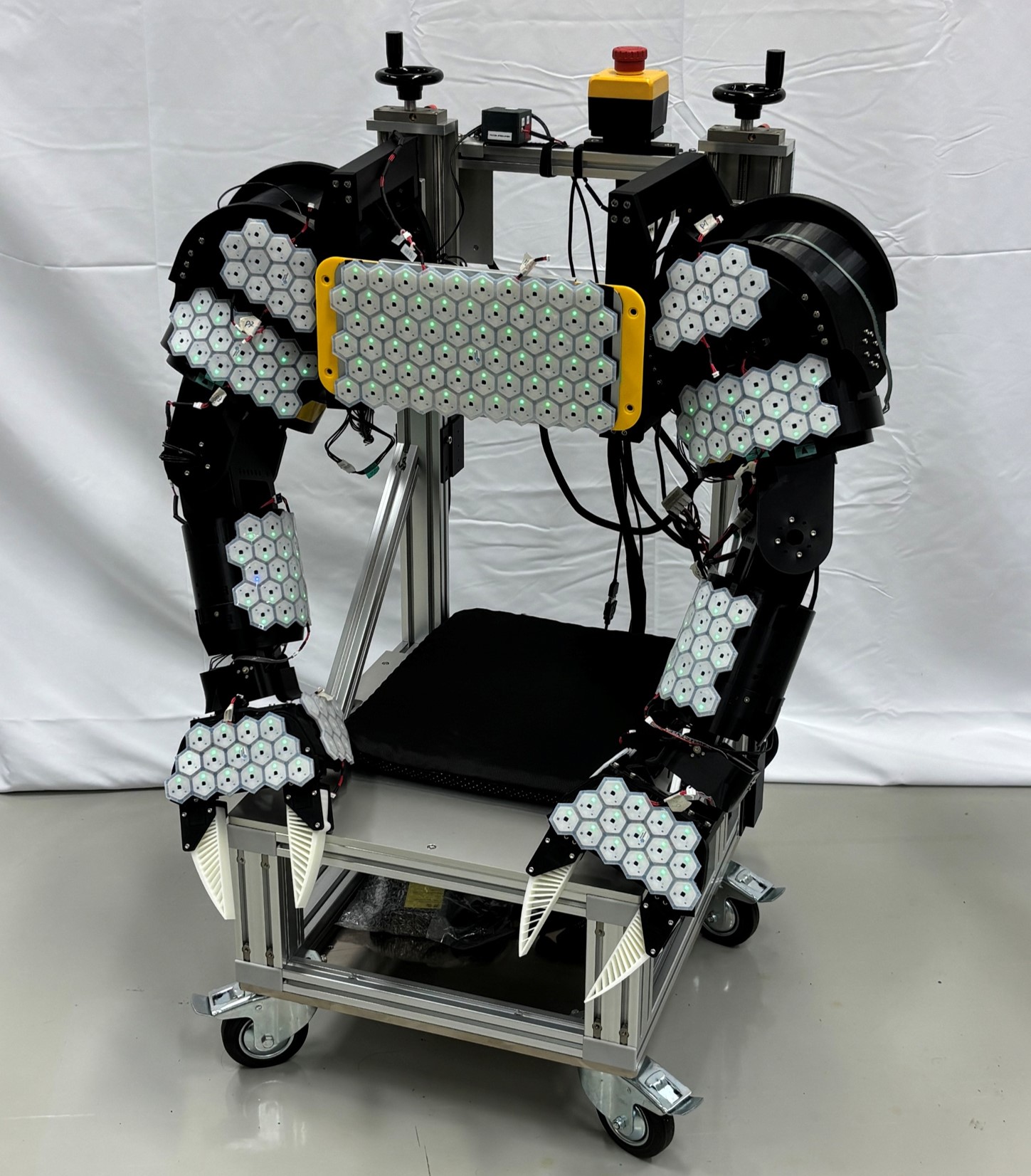
Demonstrate Execute
TWINS Isomorphic Robot
Isomorphic Robot
Mechanical structure of the TWINS arm

02 · Isomorphic design

Same morphology, direct transfer

The wearable device and execution robot share the same joint configuration and external dimensions. Each arm has seven degrees of freedom and a parallel two-finger gripper, allowing demonstrated joint angles to transfer without complex retargeting.

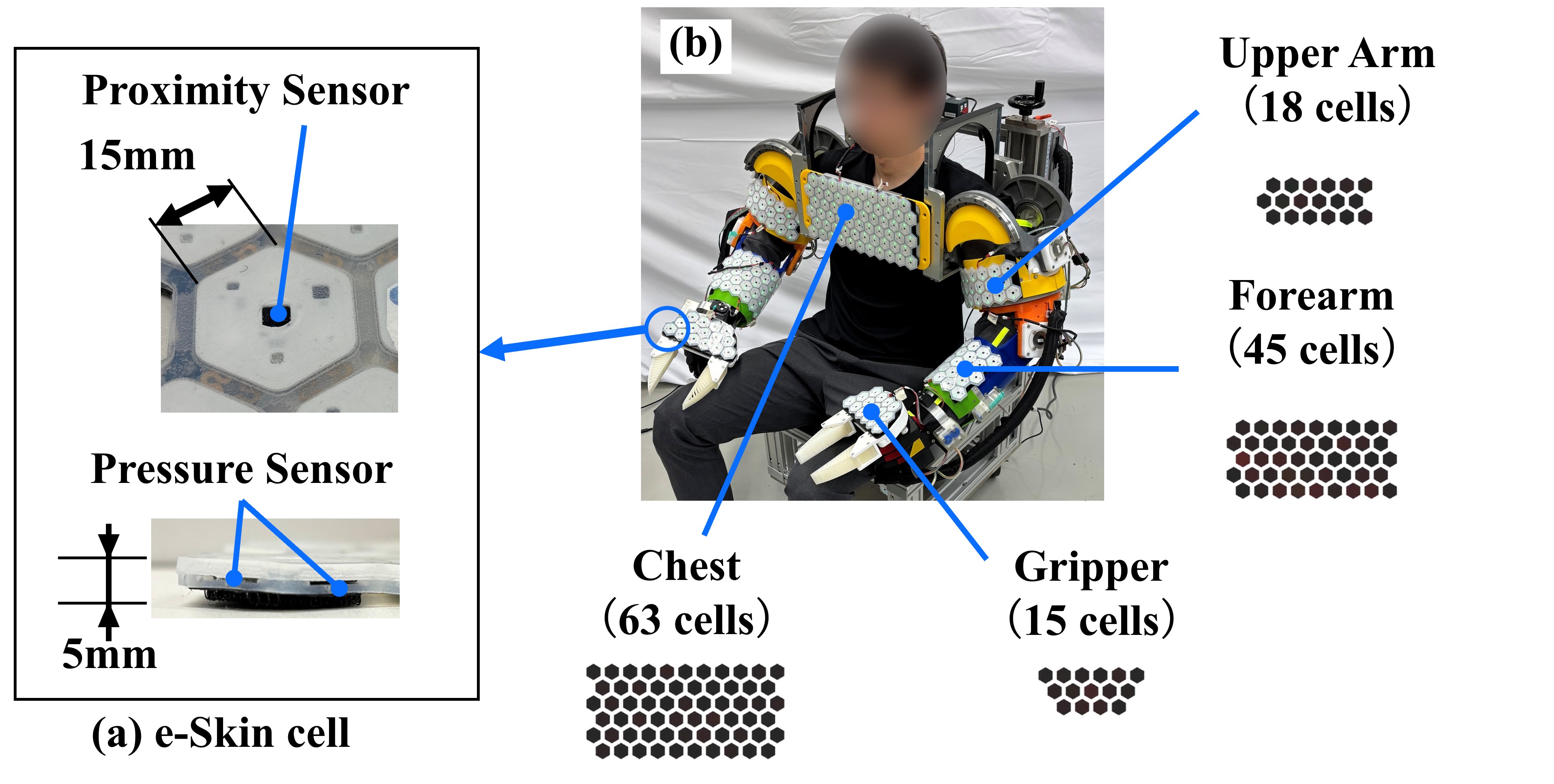
e-Skin tactile sensor structure and sensor placement on TWINS

03 · Distributed touch

Body-surface tactile sensing

Pressure and proximity are measured across 219 tactile cells placed on the chest, upper arms, forearms, and grippers—capturing contact beyond the end effectors.

Experiment Videos

We evaluate TWINS on four contact-rich tasks by collecting 10 demonstrations per task with the Wearable Dual-Arm Device and deploying imitation-learning policies trained with Diffusion Policy on the Isomorphic Robot.

All videos on this page are shown at real-time speed (1×).

Adaptive Holding

Data Collection
Policy Rollout

Ball Placing

Data Collection
Policy Rollout

Towel Hanging

Data Collection
Policy Rollout

Basket Holding

Data Collection
Policy Rollout

Tactile Sensor Visualization

Body-surface tactile measurements are visualized for both data collection and policy rollout.

Adaptive Holding

Data Collection
Policy Rollout

Ball Placing

Data Collection
Policy Rollout

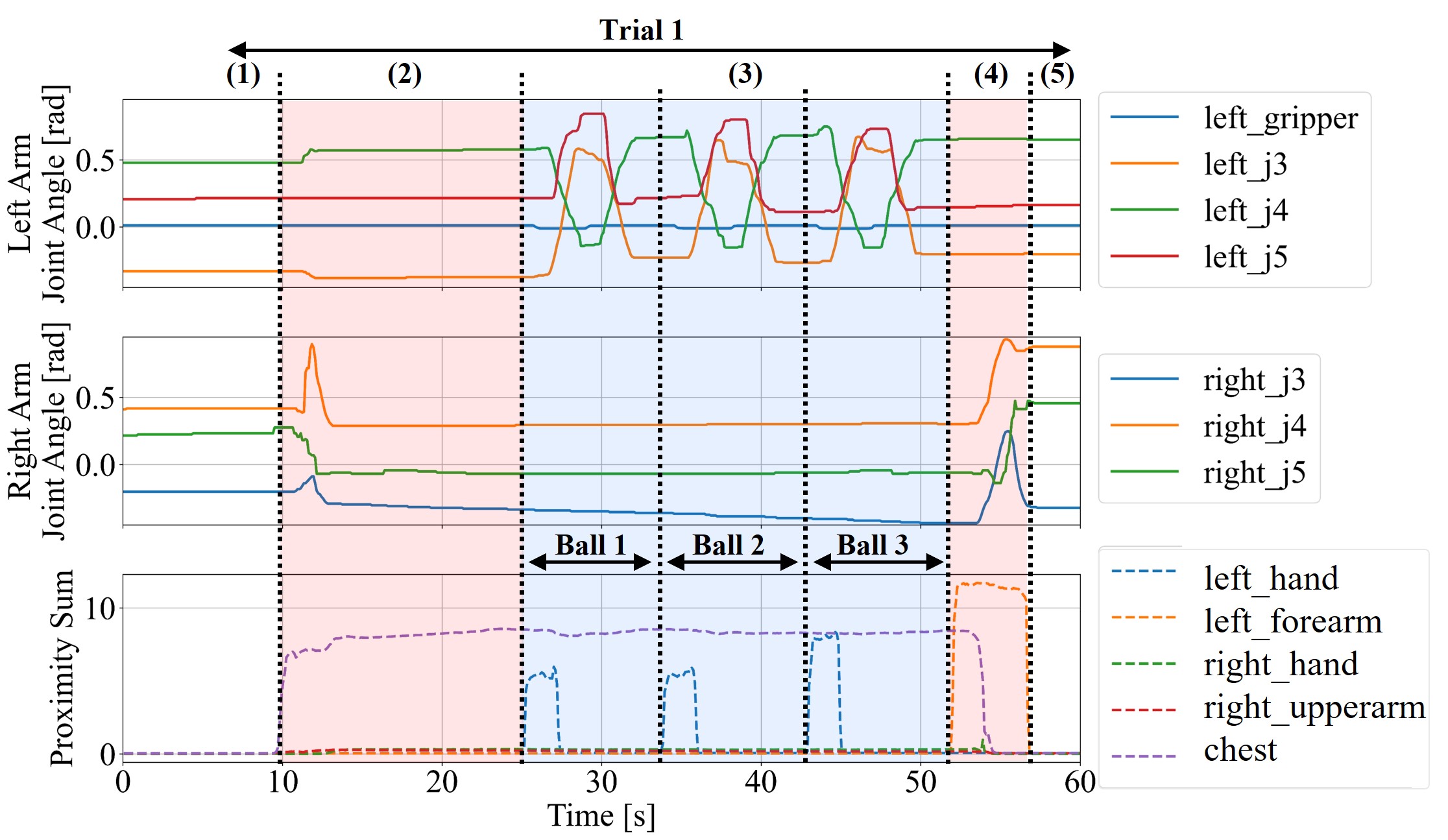
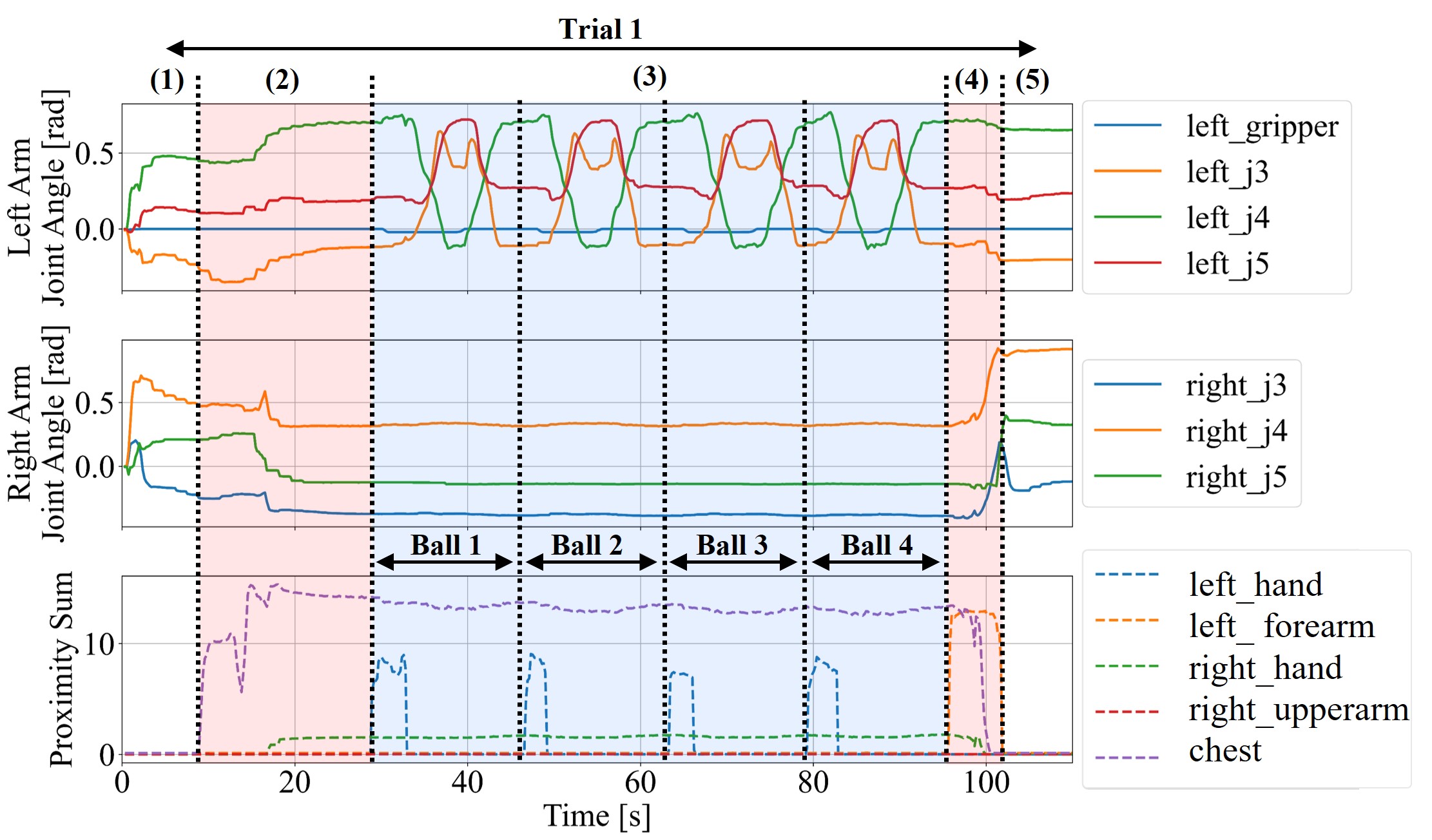
Tactile-Guided Behavior

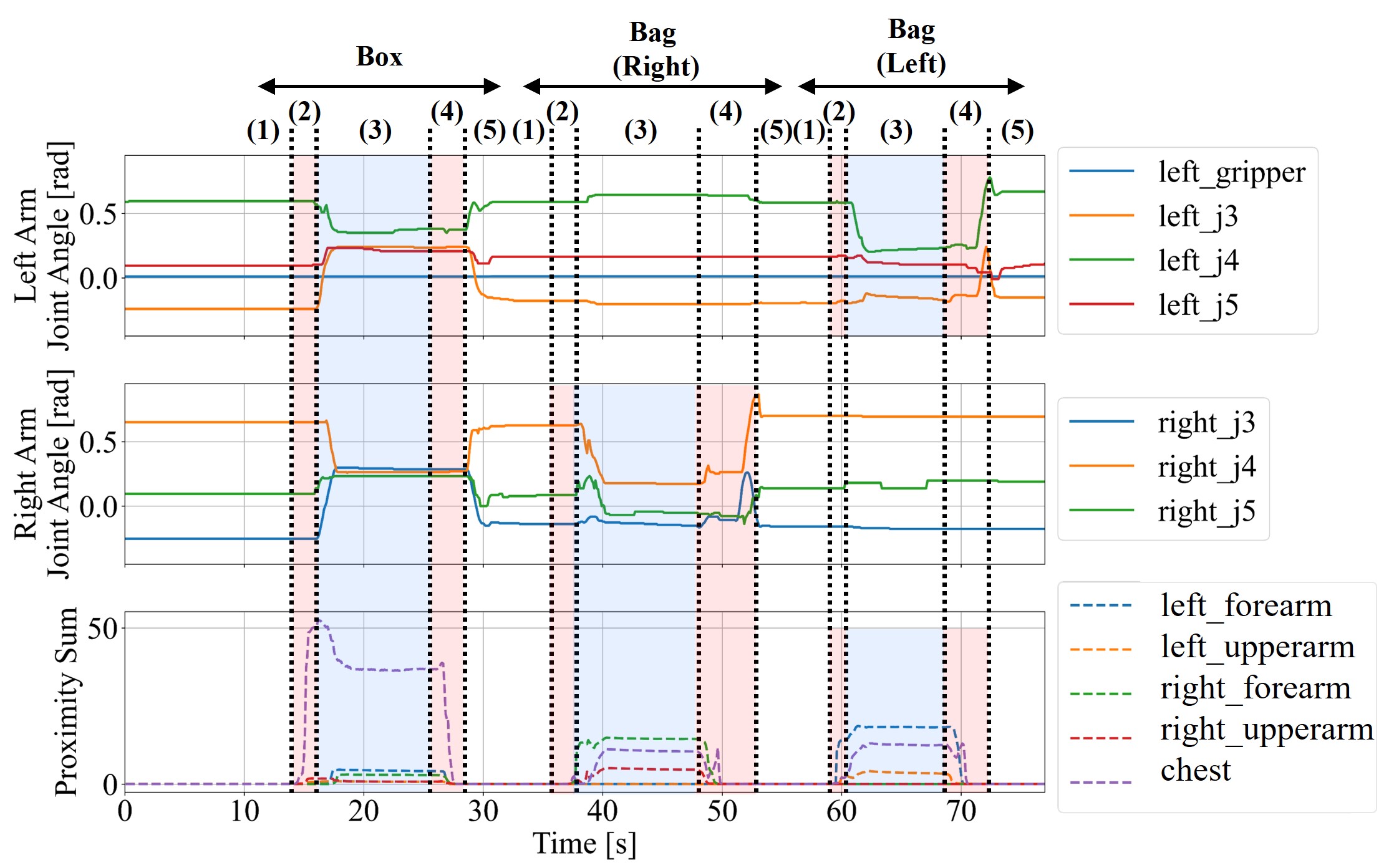
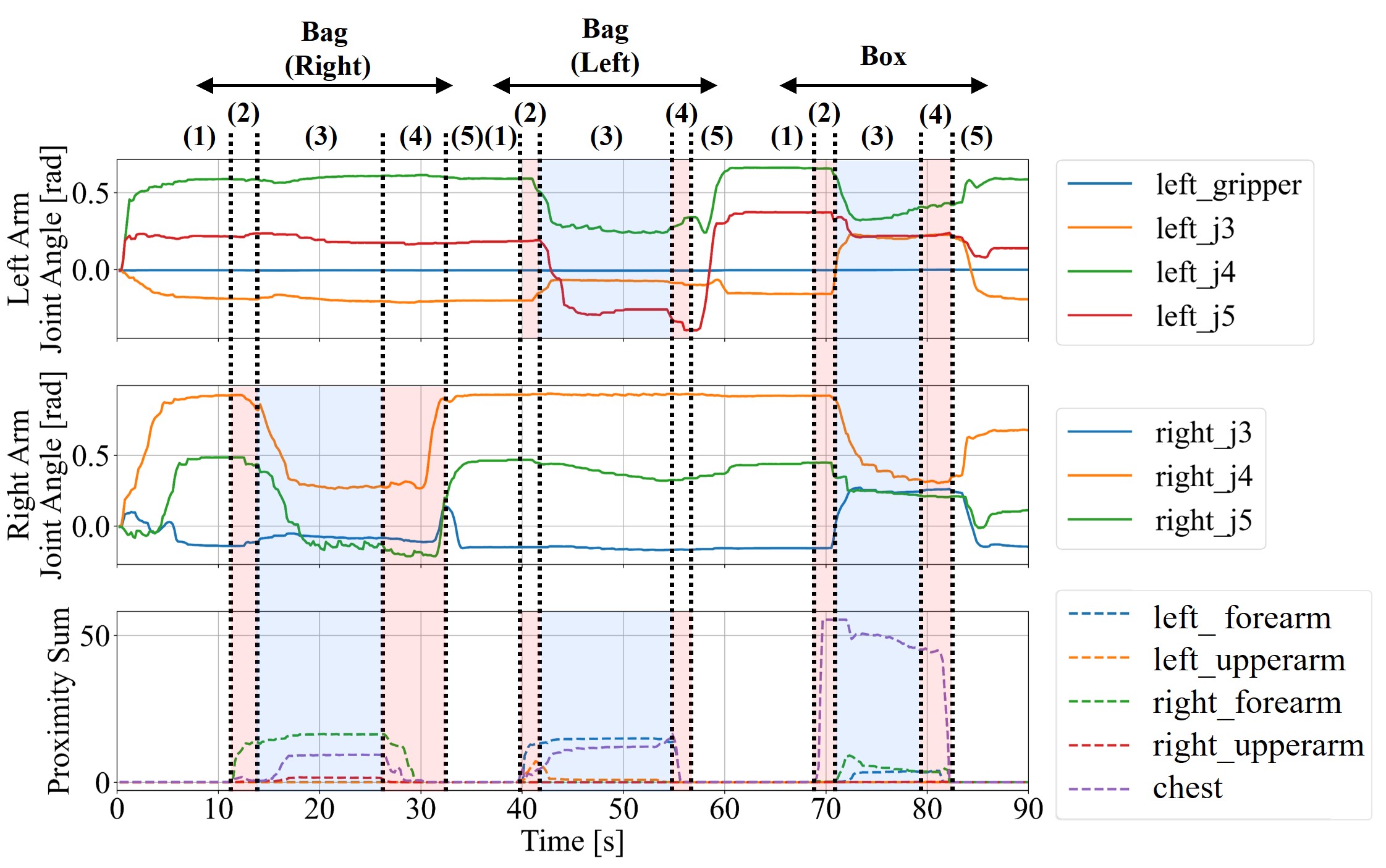
Recorded joint angles and tactile measurements are shown with data collection on the left and the corresponding policy rollout on the right.

Adaptive Holding

Joint and tactile data during the Adaptive Holding demonstration
Data Collection
Joint and tactile data during the Adaptive Holding policy rollout
Policy Rollout

Ball Placing

Joint and tactile data during the Ball Placing demonstration
Data Collection
Joint and tactile data during the Ball Placing policy rollout
Policy Rollout

BibTeX

@misc{kitamura2026twins,
  title   = {TWINS: A Tactile Wearable Isomorphic Arm Networked System for Contact-Rich Manipulation Learning},
  author  = {Takahide Kitamura and Masaki Murooka and Natsuki Yamanobe and Yukiyasu Domae},
  year    = {2026},
  eprint  = {2608.01733},
  archivePrefix = {arXiv},
  primaryClass  = {cs.RO},
  url     = {https://arxiv.org/abs/2608.01733v1}
}